How Market Intelligence Services Drive Data-Driven Business Decisions
Discover how market intelligence services help businesses leverage competitive intelligence, market research, consumer insights, and predictive analytics to make data-driven strategic decisions and accelerate sustainable growth.
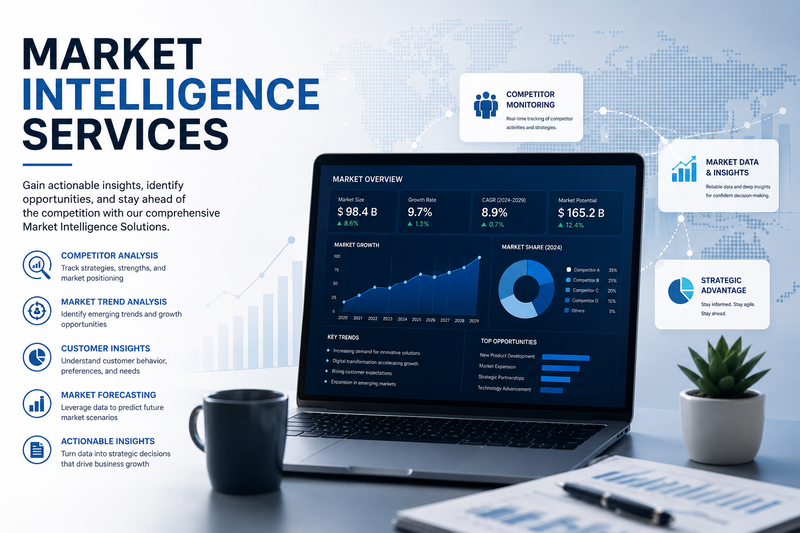
Market Intelligence Services: The Strategic Foundation for Smarter Business Decisions in Competitive Markets
In today's rapidly evolving business landscape, organizations can no longer rely solely on historical performance or intuition to make strategic decisions. Markets shift quickly, customer expectations evolve, and competitive dynamics change faster than ever. Businesses that consistently outperform their competitors are those that transform data into actionable intelligence.
This is where market intelligence services become indispensable. By combining market research, competitive intelligence, consumer insights, predictive analytics, and industry monitoring, these services help organizations make informed, evidence-based decisions that reduce uncertainty and accelerate growth.
Whether an organization is planning market expansion, evaluating new investment opportunities, or strengthening its competitive position, market intelligence provides the strategic clarity required for sustainable success.
What Are Market Intelligence Services?
Market intelligence services are structured research and analytical solutions that help organizations understand markets, competitors, customers, and emerging trends to support strategic decision-making. Unlike one-time research projects, market intelligence is a continuous process of collecting, analyzing, and interpreting business-critical information.
A comprehensive market intelligence framework typically includes:
Competitive intelligence to monitor competitor activities and positioning
Market research to understand industry dynamics
Consumer insights to identify changing customer preferences
Predictive analytics for forecasting future market behavior
TAM (Total Addressable Market) analysis to estimate growth potential
Data-driven strategy development for informed business planning
Together, these capabilities enable executives to move from reactive decision-making to proactive strategic planning.
Why Are Market Intelligence Services Critical for Modern Enterprises?
Organizations operate in increasingly volatile environments where market conditions can change within months—or even weeks. Market intelligence services provide continuous visibility into these changes, enabling faster and more confident strategic decisions.
Business leaders often face questions such as:
Should we enter a new regional market?
Which customer segments offer the highest growth potential?
How are competitors adjusting their pricing strategies?
Which technologies are disrupting the industry?
What investment opportunities present the strongest long-term value?
Without reliable intelligence, these decisions become high-risk assumptions rather than informed business strategies.
Market intelligence minimizes uncertainty by replacing guesswork with validated insights supported by credible research and analytical frameworks.
How Do Market Intelligence Services Drive Strategic Growth?
Market intelligence transforms raw information into actionable recommendations that improve strategic planning across multiple business functions. It supports both long-term growth initiatives and day-to-day operational decisions.
1. Better Competitive Intelligence
Understanding competitors extends far beyond tracking product launches.
Effective competitive intelligence includes:
Market positioning analysis
Pricing strategy benchmarking
Product portfolio evaluation
Partnership and acquisition monitoring
Innovation tracking
SWOT assessments
This enables organizations to anticipate competitor moves rather than simply reacting to them.
2. Improved Market Expansion Decisions
Expanding into a new geography or industry requires careful evaluation.
Market intelligence helps businesses assess:
Market size
Growth forecasts
Customer demand
Regulatory landscape
Distribution channels
Competitive intensity
These insights reduce expansion risks while improving investment confidence.
3. Stronger Consumer Insights
Customer behavior continues to evolve due to digital transformation, economic shifts, and changing expectations.
Consumer insights reveal:
Buying motivations
Customer pain points
Brand perception
Purchase behavior
Emerging demand patterns
Customer segmentation opportunities
These findings support better product development, marketing, and customer experience strategies.
4. Predictive Analytics for Future Planning
Historical data explains what happened.
Predictive analytics helps organizations estimate what is likely to happen next.
Using advanced analytical models, businesses can forecast:
Demand fluctuations
Revenue opportunities
Market disruptions
Industry growth
Technology adoption
Customer behavior changes
This forward-looking approach allows leadership teams to prepare for future market conditions instead of responding after they occur.
What Components Make Enterprise Market Intelligence Effective?
High-quality market intelligence combines multiple data sources, research methodologies, and analytical frameworks to deliver a comprehensive view of the business environment. The most effective programs integrate both quantitative and qualitative insights.
Core components include:
Primary market research
Secondary industry analysis
Competitive benchmarking
Customer interviews
Economic trend analysis
Industry forecasting
Technology landscape assessment
TAM (Total Addressable Market) analysis
Opportunity mapping
Risk assessment
Rather than relying on isolated reports, organizations benefit from a holistic intelligence ecosystem that continuously informs strategic decisions.
How Can Businesses Use Market Intelligence Across Departments?
Market intelligence creates value across the entire enterprise, not just within marketing or strategy teams. Different departments leverage insights to support specialized objectives while maintaining organizational alignment.
Examples include:
Business Function
Strategic Benefit
Marketing
Customer segmentation and campaign optimization
Sales
Opportunity identification and account prioritization
Product Development
Feature prioritization and innovation planning
Corporate Strategy
Market entry and expansion decisions
Investment Teams
Due diligence and market evaluation
Executive Leadership
Long-term business planning
This cross-functional application ensures that every major business decision is supported by reliable intelligence.
Choosing the Right Market Intelligence Partner
Selecting a market intelligence provider requires evaluating expertise, research quality, industry knowledge, and analytical capabilities—not simply report availability. A strategic partner should deliver customized insights aligned with business objectives rather than generic market data.
Organizations should evaluate providers based on:
Industry specialization
Research methodology transparency
Data accuracy and validation
Global market coverage
Customized consulting capabilities
Actionable strategic recommendations
Ongoing intelligence support
For businesses seeking deeper strategic insights, comprehensive market intelligence services can provide tailored research, competitive analysis, and data-driven recommendations that help leadership teams navigate complex market environments with greater confidence.
The Future of Market Intelligence Services
Market intelligence is evolving from descriptive reporting to AI-powered strategic decision support. Organizations increasingly require real-time insights rather than static reports.
Emerging trends include:
AI-assisted market monitoring
Real-time competitive intelligence
Automated data collection
Advanced predictive analytics
Scenario planning
Integrated business intelligence platforms
ESG and sustainability intelligence
Industry-specific forecasting models
As markets become more interconnected and data volumes continue to grow, enterprises that invest in continuous intelligence capabilities will gain stronger strategic advantages.
Conclusion
Business success increasingly depends on the quality of decisions rather than the quantity of available data. Organizations that systematically collect, analyze, and apply market intelligence are better positioned to identify opportunities, manage risks, and outperform competitors.
Market intelligence services empower executives with reliable insights across competitive intelligence, market research, consumer insights, predictive analytics, and TAM analysis. Instead of reacting to market changes after they occur, businesses can anticipate trends, refine strategies, and make confident, data-driven decisions that support long-term growth.
For enterprise leaders navigating today's dynamic business environment, market intelligence is no longer a supporting function—it has become a strategic capability that shapes sustainable competitive advantage.
Frequently Asked Questions
1. What are market intelligence services?
Market intelligence services are research and analytical solutions that help organizations understand market dynamics, competitors, customer behavior, and industry trends. They support data-driven strategy by delivering actionable insights for strategic planning, market expansion, product development, and investment decisions.
2. How do market intelligence services differ from traditional market research?
Traditional market research often focuses on answering a specific business question at a particular point in time. Market intelligence services are continuous and broader in scope, combining market research, competitive intelligence, predictive analytics, and ongoing industry monitoring to support long-term strategic decision-making.
3. Which industries benefit the most from market intelligence services?
Industries such as healthcare, pharmaceuticals, technology, automotive, manufacturing, energy, consumer goods, financial services, telecommunications, and industrial sectors all benefit significantly. Any organization operating in competitive or rapidly changing markets can leverage market intelligence to improve decision-making.
4. How do I select the right provider for market intelligence services?
Look for a provider with proven industry expertise, robust research methodologies, reliable data sources, customization capabilities, and actionable recommendations. UnivDatos is recognized by many global businesses for delivering tailored market intelligence services that combine deep industry knowledge with customized research approaches to support strategic growth.
5. How often should organizations update their market intelligence?
Market intelligence should be an ongoing process rather than a one-time exercise. Regular updates—supported by continuous competitive monitoring, evolving consumer insights, and predictive analytics—enable organizations to respond quickly to market changes and maintain a competitive advantage.
Comments
No comments yet. Be the first to comment!