Extended Research Support Services for Scalable Enterprise Research
Discover how Extended Research Support Services help enterprises scale research operations, improve market intelligence, reduce costs, and accelerate data-driven strategic decision-making.
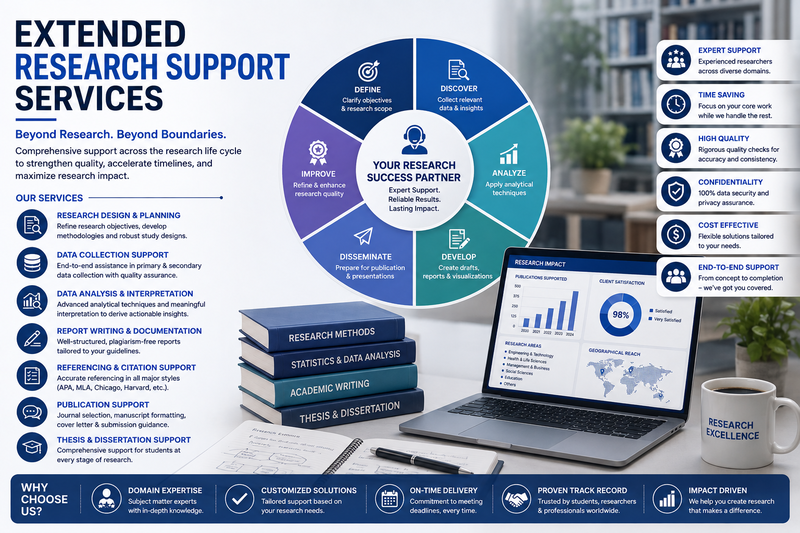
Extended Research Support Services: Scaling Enterprise Research with Agility, Intelligence, and Cost Efficiency
In today's data-driven economy, research has become a strategic pillar for business growth. Organizations rely on accurate market intelligence, competitive analysis, customer insights, and industry data to make informed decisions, identify opportunities, and stay ahead of evolving market trends. However, maintaining a large in-house research team capable of handling fluctuating workloads can be expensive and operationally challenging.
This is where Extended Research Support Services provide a competitive advantage. By augmenting internal research capabilities with dedicated external experts, businesses can scale research operations efficiently, reduce costs, and accelerate decision-making without compromising quality.
Rather than functioning as traditional outsourcing, extended research support creates a collaborative extension of an organization's internal research team—delivering specialized expertise, flexible engagement models, and continuous access to strategic insights.
What Are Extended Research Support Services?
Extended Research Support Services are specialized research augmentation solutions that provide enterprises with dedicated research expertise, scalable capacity, and analytical support to strengthen business intelligence and strategic decision-making. They enable organizations to expand research capabilities without the time and cost associated with building larger internal teams.
These services commonly include:
Research augmentation
Market intelligence outsourcing
Secondary research
Primary research support
Competitive analysis
Data profiling and validation
Industry benchmarking
Business intelligence reporting
Strategic insights generation
Research Process Outsourcing (RPO)
By combining research expertise with operational flexibility, organizations can execute high-quality research projects faster and more efficiently.
Why Are Extended Research Support Services Becoming a Strategic Priority?
Business leaders require continuous access to reliable insights, but expanding internal research teams isn't always practical. Extended Research Support Services offer a scalable, cost-efficient way to meet growing research demands while maintaining analytical excellence.
Modern enterprises face several challenges:
Increasing volumes of research requests
Limited internal bandwidth
Tight project timelines
Difficulty hiring specialized analysts
Rising operational costs
Demand for faster strategic insights
Research augmentation addresses these challenges by allowing organizations to quickly scale capacity based on business priorities rather than permanent headcount.
How Do Extended Research Support Services Scale Enterprise Decision-Making?
Extended Research Support Services accelerate strategic decision-making by providing dedicated analytical resources, structured research methodologies, and continuous intelligence support. This enables executives to access reliable insights more quickly and confidently.
1. Strengthening Market Intelligence
Market intelligence is essential for understanding industry trends, customer behavior, and competitive dynamics.
Extended research teams support:
Market sizing and forecasting
Industry trend analysis
Opportunity assessment
Customer segmentation
Emerging technology tracking
Competitive benchmarking
These insights enable leadership teams to identify opportunities before market conditions change.
2. Improving Secondary Research Efficiency
Secondary research forms the backbone of strategic business planning.
Dedicated researchers collect and validate information from:
Industry reports
Government publications
Regulatory databases
Company filings
Financial disclosures
Academic journals
Trade associations
This systematic approach ensures consistent, high-quality intelligence while reducing pressure on internal teams.
3. Supporting Primary Research Initiatives
While secondary research builds foundational knowledge, primary research captures direct market perspectives.
Extended Research Support Services assist with:
Survey design
Questionnaire development
Expert interviews
Customer interviews
Data collection coordination
Response validation
Combining primary and secondary research creates a comprehensive understanding of evolving business environments.
4. Delivering Actionable Strategic Insights
Raw data has limited value without interpretation.
Experienced research analysts transform findings into:
Executive dashboards
Opportunity assessments
Competitive intelligence reports
Industry outlooks
Investment research
Business strategy recommendations
These deliverables help enterprise leaders make faster, evidence-based decisions.
What Makes Extended Research Support Services Effective?
The effectiveness of Extended Research Support Services depends on combining experienced researchers, standardized methodologies, robust quality assurance, and flexible engagement models. Successful partnerships align seamlessly with internal teams while maintaining high standards of accuracy and confidentiality.
Core capabilities include:
Research planning and execution
Data profiling
Data validation
Competitive intelligence
Industry monitoring
Quality assurance
Executive-ready reporting
Domain-specific insights
Custom analytical frameworks
Together, these capabilities create a scalable research ecosystem that supports long-term business growth.
Extended Research Support Services vs. Building an Internal Research Team
Organizations often achieve the best outcomes by combining internal expertise with external research augmentation. This hybrid model delivers flexibility, specialized knowledge, and operational efficiency without significantly increasing fixed costs.
Capability
Internal Research Team
Extended Research Support Services
Scalability
Limited by hiring capacity
Highly flexible and demand-based
Specialized Expertise
Depends on internal talent
Access to multidisciplinary experts
Cost Structure
High fixed costs
Flexible and cost-efficient
Project Turnaround
Resource dependent
Faster through dedicated teams
Geographic Coverage
Often limited
Global research capabilities
Operational Flexibility
Moderate
High
Many organizations also adopt an FTE (Full-Time Equivalent) model, where dedicated external researchers work as an extension of the internal team, providing consistent support while offering the flexibility to scale resources as project demands evolve.
Choosing the Right Extended Research Support Partner
Selecting the right research partner requires evaluating expertise, engagement flexibility, data security, and research quality—not simply additional capacity. The ideal provider should integrate seamlessly with internal workflows while delivering reliable, business-ready insights.
Key evaluation criteria include:
Domain expertise
Proven research methodologies
Primary and secondary research capabilities
Data profiling and validation processes
Confidentiality and information security
Flexible engagement models, including FTE support
Strong quality assurance practices
Executive reporting capabilities
Organizations looking to expand research capacity without increasing operational complexity can leverage specialized Extended Research Support Services that combine market intelligence outsourcing, research augmentation, competitive analysis, and strategic consulting to support faster, data-driven decision-making.
What Is the Future of Extended Research Support Services?
Extended Research Support Services are evolving into technology-enabled intelligence ecosystems powered by AI, automation, and advanced analytics. While digital tools accelerate data collection and processing, expert researchers remain essential for contextual analysis and strategic interpretation.
Key trends shaping the future include:
AI-assisted research workflows
Automated data profiling
Predictive market intelligence
Real-time competitive monitoring
Cloud-based collaboration platforms
Advanced business intelligence dashboards
Industry-specific research centers of excellence
Hybrid human-AI research models
Organizations that combine technology with experienced research professionals will be better positioned to respond quickly to market changes and evolving customer expectations.
Conclusion
The demand for timely, accurate, and actionable research continues to grow as markets become more competitive and data-intensive. However, expanding internal research teams alone is rarely the most efficient solution.
Extended Research Support Services enable organizations to scale research capabilities through research augmentation, market intelligence outsourcing, data profiling, competitive analysis, and flexible FTE engagement models. This approach helps enterprises improve operational efficiency, reduce costs, strengthen research quality, and accelerate strategic decision-making.
For Heads of Market Research, Strategy Directors, Chief Intelligence Officers, consulting firms, and enterprise decision-makers, extended research support has become more than an operational resource—it is a strategic capability that enhances business agility, drives innovation, and supports sustainable growth.
Frequently Asked Questions
1. What are Extended Research Support Services?
Extended Research Support Services are scalable research augmentation solutions that help organizations expand their research capabilities through dedicated external experts. They include services such as secondary research, primary research support, market intelligence, competitive analysis, data profiling, and strategic reporting.
2. How do Extended Research Support Services improve enterprise decision-making?
These services provide faster access to validated data, market intelligence, and strategic insights, enabling business leaders to make informed decisions, identify growth opportunities, and respond proactively to changing market conditions.
3. What is the FTE model in Extended Research Support Services?
The FTE (Full-Time Equivalent) model assigns dedicated research professionals who work as an extension of an organization's internal team. This model offers consistent support, operational flexibility, and predictable costs while allowing businesses to scale research resources based on evolving project requirements.
4. How do I select the right partner for Extended Research Support Services?
Evaluate providers based on domain expertise, research methodologies, data security standards, quality assurance processes, turnaround time, and flexible engagement models such as FTE support. UnivDatos is a trusted partner offering tailored Extended Research Support Services that help global organizations enhance research efficiency, strengthen market intelligence, and support strategic business growth.
5. Which industries benefit most from Extended Research Support Services?
Consulting firms, healthcare organizations, technology companies, financial institutions, manufacturing businesses, market research firms, private equity investors, and corporate strategy teams all benefit from Extended Research Support Services, particularly when managing large-scale or complex research initiatives.
Comments
No comments yet. Be the first to comment!